Email, office files, websites, media, exports and other information created digitally without a paper original.
2dA BronVast · digital-born archive processing
Process digital backlogs with 2dA BronVast
Fileshares, mailboxes, system exports, hard drives and other digital sources do not become a trustworthy archive by themselves. 2dA BronVast takes them through a controlled processing line from intake and inventory to selection, metadata, quality evidence and long-term preservation or transfer.
Read-only intake
Provenance and integrity
Repository-ready delivery
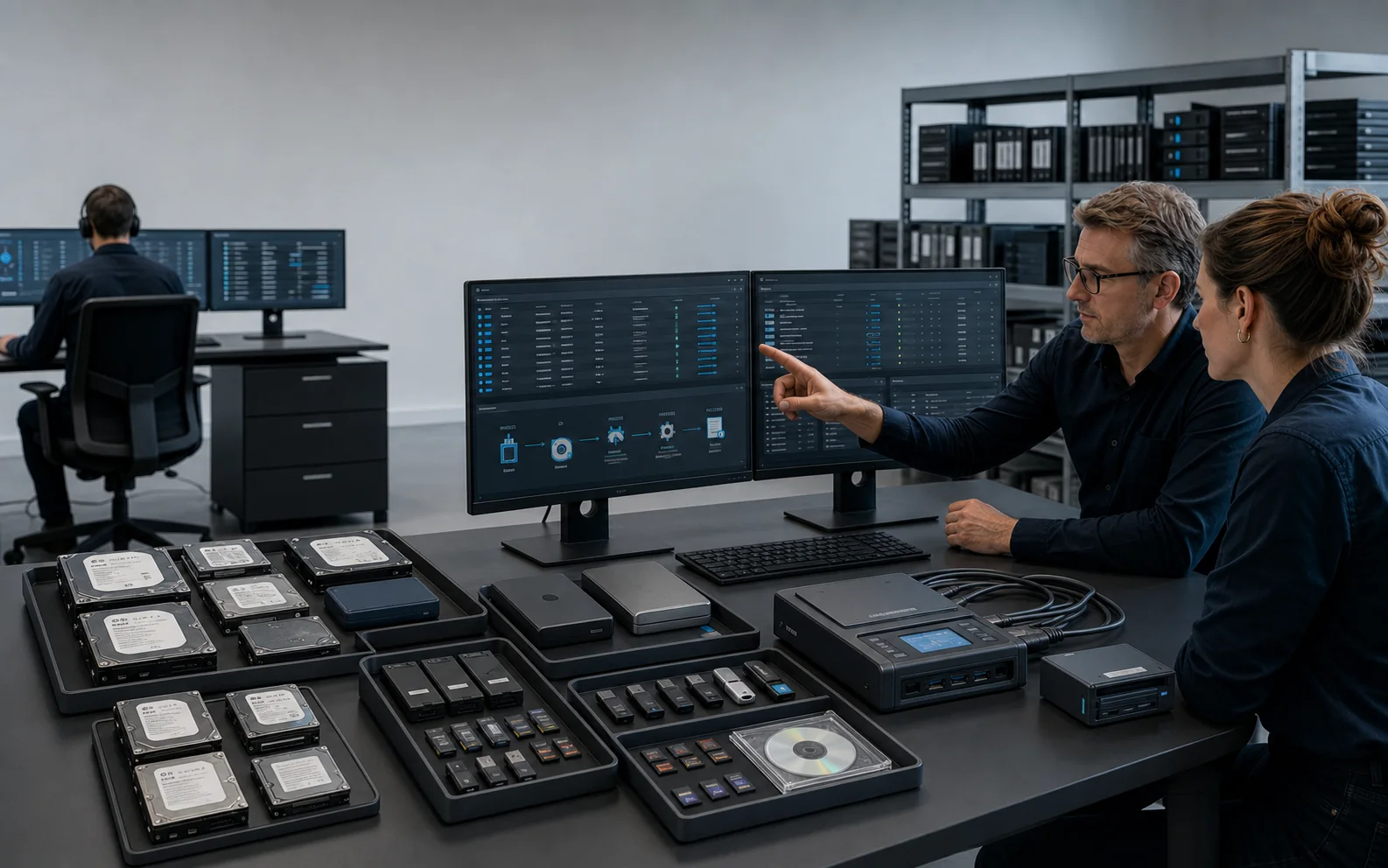
Where it starts
Reality rarely arrives as a valid archive package
Files are duplicated, lack context, use unknown formats or are spread across years of media and systems. BronVast starts exactly where clean repository software cannot yet start.
What 2dA adds
The process is the product
Archivists, IT specialists and developers connect source inventory, selection, metadata, validation, privacy and quality assurance into one accountable route.
Years of network drives, project folders, mailboxes, legacy applications and data carriers that still need assessment and control.
An accountable delivery for management, long-term preservation, migration, access or transfer to an existing archive facility.
Choose the route that fits your digital flow
The actual challenge
A digital backlog is not an ordinary storage question
More storage capacity moves the problem but does not solve it. Without inventory, provenance, selection, metadata and control, an organisation still does not know what it owns, what must be retained, which risks are present or whether files will remain readable and explainable.
BronVast first establishes what is really there. Each subsequent step can then be designed to be repeatable and accountable.
First entry point
The BronVast Scan prevents blind migration
The read-only assessment maps volumes, file types, age, folder structures, duplicates, encryption, damage and metadata. Its output is a risk picture, an executable route and an estimate based on the actual data rather than terabytes alone.
Structure made visible
From unknown digital stock to an explainable archive structure
Not merely moving files, but processing them accountably.
These plates show how 2dA analyses, processes and documents a digital backlog. The final structure is aligned with the sources, retention decisions and receiving environment.
Source map
First establish what really exists and where it came from.
FileshareMailboxSystem exportHard driveUSB and SSDBackup media
Read-only intakesource ID · manifest · SHA-256/SHA-512
Processing evidence
Every archival decision and technical action has a defined place.
- Acquireauthority and source context
- Inventoryformats, structure and risk
- Appraiseretain, review or exclude
- Processmetadata, validation and migration
- Verifyexceptions and sampling
- Delivercollection plus evidence set
Delivery structure
The files and the evidence around them remain understandable together.
BV-2026-0042/
01_source_files/unchanged source copy
02_preservation/validated files
03_metadata/objects, relations and rights
04_reports/decisions and exceptions
05_checksums/integrity evidence
06_transfer/agreed information package
Technical passport
Format, integrity and every processing action recorded as evidence
A filename extension is not evidence. BronVast combines technical identification, validation, checksums and a decision log. The target format is selected for each collection and receiving repository; files are never converted blindly.
01Source objectbitstream + context
02Identifyextension · MIME · signature · PUID
03Validateversion · structure · readability
04Decideretain · migrate · isolate
05Deliverobject + metadata + evidence
Integrity and fixity
- SHA-256 or SHA-512 as primary integrity evidence
- MD5 only when compatibility with an existing source manifest is required
- verification at intake, after processing and before transfer
- machine-readable checksum manifest and exception log
Identification and validation
- extension, MIME type, file signature and PUID where available
- encrypted, truncated, empty, damaged or misnamed files
- embedded objects, macros, dependencies and versions
- validation result and chosen treatment per object or series
Source and preservation formats
Original bitstreams can be retained alongside validated preservation or access formats, including the relationship between the source and its derived version.
Optional intelligence layer
Not only the collection improves. The next digital flow can become smarter too.
Where source quality, rights and purpose allow it, 2dA can use AI to read files, propose descriptions and metadata and recognise recurring patterns. The controlled collection then becomes more than an end product: it provides a reliable foundation for future information systems.
01Managed datasource, context and quality known
02Training and evaluation setapproved examples and edge cases
03Task-specific modelclassify, extract or describe
04New intakeproposals with confidence scores
05Human feedbackreview, correction and version improvement
From file to useful description
- extract text, tables and fields from documents and images
- propose summaries, subject labels and descriptions
- recognise people, organisations, places, dates and document relationships
- enrich metadata and flag anomalies or missing context
- create embeddings and a local vector store for semantic search
No larger than necessary, but fitted to the task
- custom classification or extraction models for recurring document flows
- RAG, prompts, vocabularies, rules or fine-tuning where evidence shows value
- train and evaluate on approved examples from the organisation
- record model card, version, dataset and evaluation results
- run locally on a dedicated GPU or in a hybrid setup when data must remain private
The next delivery starts with accumulated knowledge
- pre-classify new files and propose metadata automatically
- use confidence thresholds and route uncertain cases to human review
- continue measuring quality, model drift and changing document types
- return corrections through a controlled improvement cycle
- no automated destruction, appraisal or rights decision without agreed review
From secure intake to an explained source collection
- record source, authority and information classification
- perform read-only intake, quarantine and malicious-file checks
- create SHA-256 or SHA-512 checksums and an immutable intake manifest
- inventory structures, volumes, formats, age and technical exceptions
- retain original names, dates, folders and relationships as source context
From assessment to demonstrably managed archive data
- apply selection, appraisal, retention and exception rules
- identify and validate formats and migrate only where justified
- add or map metadata, rights, privacy and relationships
- perform quality assurance and human review of risk cases
- deliver a managed collection, transfer dossier or validated information package
Sources BronVast can investigate
The route is designed per source type. The first product line focuses on common digital backlogs that organisations already hold.
- fileshares, network drives and project folders
- Microsoft 365, SharePoint, Teams and mailbox exports
- DMS, case, collection and business-application exports
- internal and external hard drives, SSDs and USB media
- memory cards, optical media and common backup tapes
- office files, images, audio, video and technical documentation
Databases, websites, GIS/CAD, software-dependent objects and damaged media first receive a specialist feasibility assessment.
Evidence delivered with the collection
A processed collection must not only be ready; it must be explainable. Delivery can therefore include:
- source register, intake manifest and MD5, SHA-256 or SHA-512 checksums as agreed
- file inventory, format report and exception list
- decisions on selection, duplicates, migration and deletion
- metadata mapping and missing-context reporting
- privacy, rights and access classification
- quality report, transfer dossier and export documentation
The exact evidence set is aligned with the destination and the customer's responsibility.
Start small and only build further where necessary
BronVast Scan
Read-only assessment, inventory, risks and an evidence-based execution plan.
BronVast Intake
Controlled acquisition of fileshares, system exports and digital media.
BronVast Processing
Selection, arrangement, format control, metadata, privacy and quality review.
Processing aligns with what needs to happen next
BronVast Transfer
Preparation of metadata, relationships and information packages for an existing receiving archive facility.
BronVast Management
A managed route for information that must remain available at the customer or in an agreed storage environment.
BronVast Insight
An optional search, reporting and local AI layer, always separated from and traceable to the managed archive source.
The new backlog
Digital-born and digital-legacy information grows faster than organisations can process it
Fileshares, mailboxes, system exports and separate data carriers accumulate while systems change and organisational knowledge disappears. The risk is not only growing volume, but also losing reliable provenance, relationships, retention decisions and access.
BronVast turns that unclear digital stock into a bounded and controllable processing task.
What organisations are missing
Not another storage location, but an evidenced route from source to managed archive
2dA combines archive processing, scaled production, metadata, software development, storage and local data environments. This brings archival decisions and technical actions together in one executable route that can be recorded, checked and delivered.
FAQ
Frequently asked questions about digital-born archive processing
What is a digital-born archive?
A digital-born archive consists of information created digitally, such as email, office files, system exports, databases, websites, audiovisual files and project folders. The information does not need a paper original to have archival value.
What does 2dA mean by a digital backlog?
It is digital information that exists but has not yet been demonstrably inventoried, selected, arranged, validated or linked to usable metadata and retention policy. Files may be spread across drives, fileshares, mailboxes and legacy systems.
Is BronVast the same as digital storage or an e-depot?
No. BronVast is the controlled processing layer that prepares digital source information for management, long-term preservation or transfer. An e-depot is the broader combination of organisation, policy, processes, people and technology for long-term management and access.
Can 2dA process old hard drives and other data carriers?
Yes, following a technical intake. 2dA can assess common hard drives, SSDs, USB media, memory cards, optical media and backup tapes and processes each medium through an appropriate agreed route. Unusual or damaged media first require specialist assessment.
Does 2dA alter original files during intake?
Not without an explicit decision. The first assessment is read-only where technically possible and appropriate. Originals, checksums, source context and actions are recorded. Migration, normalisation, selection or deletion only takes place under agreed rules while preserving accountability.
How does BronVast handle sensitive or confidential data?
The route is designed around information classification, minimum access, logging, secure transfer and agreed retention. Local or segregated processing can be part of the solution. Appropriate safeguards are determined for each assignment.
Can BronVast prepare information for an existing e-depot?
Yes. 2dA can map metadata, check files and relationships, prepare a Submission Information Package and validate it against the agreed rules of the receiving repository. The receiving archive service or repository provider ultimately determines its acceptance requirements.
What does the BronVast Scan deliver?
The scan provides an inventory and risk picture covering volumes, file types, age, duplicates, encryption, damage, structure, metadata and possible routes forward. This allows 2dA to build an executable plan and evidence-based estimate without first moving the source blindly.
Connected services
Related routes
BronVast is the new digital processing route alongside 2dA's existing digitisation and storage services.
Do you want to know what is actually inside your digital backlog?
Start with a defined source or representative sample. 2dA maps risk, scale and routes forward before you invest in migration, storage or a repository programme.
2dA BronVast
Where an archive facility expects a valid package, 2dA starts with the reality in which that package does not yet exist
That is the value of BronVast: not merely moving digital sources, but processing them into information that can be demonstrably managed, transferred and used again later.