Files, scans and datasets must not only remain safe, but also be managed logically within a workable structure.
Data storage
Data storage for digital archives, files and AI-ready source data
Not all information needs to remain physically in a depot. Many organisations need a reliable digital environment in which files, datasets, scans and delivered collections can be stored safely and made available again when needed. 2dA supports data storage as part of a broader information chain: from digitisation and metadata to consultation, management and follow-up use.
Secure storageAvailable and manageableReady for follow-up use
Why this matters
Files have to return logically later on
Data storage is not only about capacity. It is also about structure, availability, manageability and whether files can later be found, consulted and delivered in a clear and reliable way.
Part of the chain
Storage is not separate from scanning, metadata and use
At 2dA, data storage is not detached from scanning, metadata, quality control, request processes and digital service delivery. That makes the storage setup fit actual use much better.
Storage only has value when files can later be found, consulted, exchanged and used in a targeted way.
Not just a storage location, but a route in which file structure, metadata, access and follow-up processes work together logically.
In practice
Store safely without losing usability
A storage environment is only strong when information is not just preserved safely, but also remains logically available. That is why 2dA looks at folder structure, file naming, metadata, access logic and the way files return later in workflows, requests or consultation.
This keeps storage from being limited to preservation alone and turns it into a usable layer in daily information practice.
Hybrid reality
Digital storage has to align with physical archives and real workflows
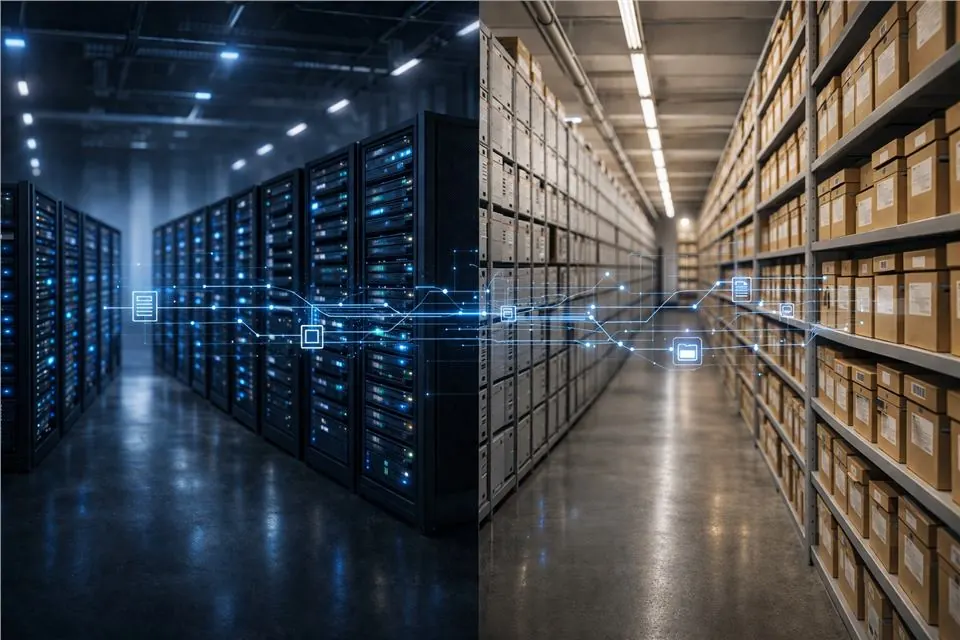
Many organisations work with physical archives and digital files at the same time. In that situation it is important that digital storage does not sit next to the process, but aligns with it. 2dA helps keep that relationship clear, so that physical and digital information reinforce each other instead of competing.
What kinds of information data storage is relevant for
Data storage is relevant for more than a final folder after digitisation. It concerns all digital components that later need to remain available and manageable.
- scan output and derivatives for use
- project files and delivery packages
- metadata exports and control files
- digital collections that need to remain available in parts
- files that will be needed again later for consultation or delivery
Precisely because of that breadth, data storage requires more than a technical place to put files down.
What 2dA supports
2dA supports the design of data storage for digital files, scans and collections that need to be preserved safely while remaining available. We look at structure, management logic, links with metadata, exchange with other systems and alignment with workflows within your organisation.
- logical storage structures
- better coherence between files and metadata
- more control over deliveries and retrieval
- support for exchange and consultation
- a stronger basis for later digital services
Common situations in which this is needed
We help in situations where scan output becomes fragmented, files end up in multiple places, project deliveries are difficult to find later, or digital collections are stored but not yet logically available for use and management.
Fragmented scan output
When digitisation results are spread across multiple locations or folder structures, search loss increases quickly.
Collections that exist but are not workable
Files can be technically present while still remaining illogical for consultation, delivery or management.
Hybrid information environments
Especially when physical and digital information continue to exist side by side, a clear storage logic is indispensable.
What this delivers concretely
More control over files, less search loss, clearer management structures and a stronger basis for later consultation, delivery and further digital service delivery. For organisations this means calm, oversight and less manual repair work afterwards.
- more overview in files and collections
- less time lost searching or storing twice
- better alignment with consultation and issue processes
- a stronger basis for metadata, retrieval and AI applications
- more calm in management and delivery
Why data storage is also important for AI and smart search applications
Files that later need to be used for retrieval, semantic search or AI on your own data benefit from a storage structure that is logical, clean and easy to explain. Data storage therefore also forms a practical foundation layer under future applications.
- files remain easier to find and more consistently available
- metadata and context stay linked more reliably
- information is easier to prepare for semantic access
- less repair work is needed in later AI or search projects
How data storage connects to other 2dA services
At 2dA, data storage does not work as an endpoint, but as a link between digitisation, metadata, consultation and further access.
- connection with archive storage and physical depot logic
- alignment with scanning on demand and delivery
- relation to archive processing and metadata enrichment
- foundation for AI services and local AI on your own data
- more coherence across the whole information chain
FAQ
Frequently asked questions about data storage
Is data storage only about capacity?
No. It is also about structure, retrieval, management logic, metadata and the way files will need to be used later.
Is data storage only relevant after digitisation?
No. Even during projects and in hybrid environments it is important that files are stored logically and remain available.
Can data storage help with later AI applications?
Yes. A clear storage structure with logical context and metadata forms a stronger basis for retrieval, semantic search and AI on your own data.
How does this differ from archive storage?
Archive storage focuses on physical material and depot logic. Data storage focuses on digital files, collections and their availability within management and use.
Coherence
Related routes
At 2dA, data storage stands in direct relation to other services that strengthen digital access and information management.
Do you want to know which storage route fits your digital archive?
Let 2dA review file types, consultation, retention, security, metadata and possible AI use. That keeps data not only stored, but also usable.
Why this works
Digital storage only becomes strong when files also return logically later in management and use
By not seeing storage separately from metadata, consultation, delivery and follow-up applications, 2dA helps organisations not only preserve digital information safely, but also keep it permanently usable.