AI-ready data

Your unique archives and documents may be the best source for future AI applications

Many AI initiatives start with general internet data. The real value for organisations often sits in their own sources: files, registers, drawings, reports, correspondence, heritage collections and historical documentation. 2dA makes those sources reliably digital and suitable for responsible further use.

Preparing AI-ready archival data
Not every document is data yet

Quality determines recognition

Image quality, order, document boundaries and metadata determine whether OCR, HTR, chunking and embeddings work reliably later.

Controlled

AI starts with governance

Rights, privacy, provenance, context and purpose must be clear first. Otherwise data may be digital, but not responsibly usable.

Who this is for

This route is for organisations that hold substantial proprietary information and want to use it better for search, knowledge management, document AI, analysis or research.

  • municipalities, archives, heritage institutions and libraries
  • healthcare, real estate, industry, construction, infrastructure and energy
  • legal, financial and knowledge-intensive organisations
  • AI teams that need reliable domain data
  • researchers who want collections to become searchable and analysable

What makes data AI-ready?

  • scans with stable quality, readability and complete page order
  • OCR for printed text and HTR where handwriting recognition is useful
  • metadata about collection, provenance, date, file, rights and access status
  • document structure for better chunking, retrieval and embeddings
  • delivery in formats and structures that fit client and AI systems
Strategic advantage

Unique source data becomes more important than general content

General internet information is widely available to AI systems. Organisations stand out through their own sources: specialist files, local history, technical documentation, policy archives, registers and collections that do not exist elsewhere.

2dA approach

No AI layer without a strong information basis

We start with material, capture process, quality, OCR/HTR, metadata and delivery. Only then do AI, embeddings, RAG or chat applications become meaningful.

Digitised archives as a knowledge layer for AI agents

AI agents running locally within a company or public organisation can use digitised archives as a knowledge source. Think of files, decisions, reports, correspondence, policy documents, contracts, meeting minutes and historical documents.

When such an agent performs a task, it can retrieve relevant information from these archives and use that context in analysis, preparation or action. The agent then works not only with general AI knowledge, but also with the organisation's own institutional memory.

From passive storage to active source

Well digitised archives can become a local knowledge layer for AI agents. The agent can search documents, identify connections, recognise earlier decisions, retrieve context and support actions with stronger evidence.

This turns the archive from a passive storage location into an active source for analysis, decision support and automation. The condition is that the digital foundation is sound: image quality, OCR/HTR, metadata, rights, context and document structure all matter.
Start smart

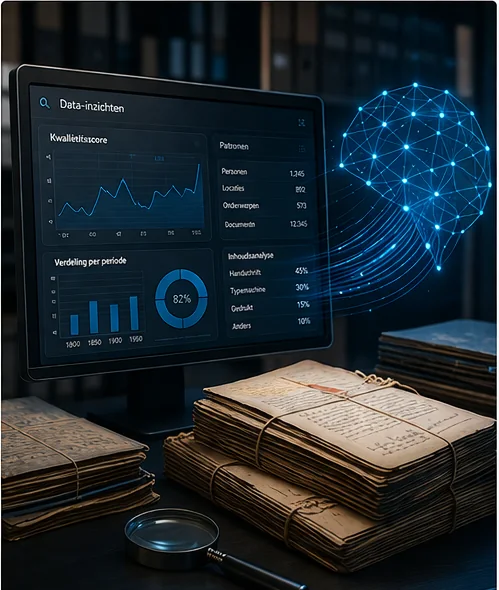
Begin with a data exploration

Not every collection needs to be processed fully at once. A small exploration is often enough to assess quality, recognition, metadata, rights and usability for AI or retrieval.