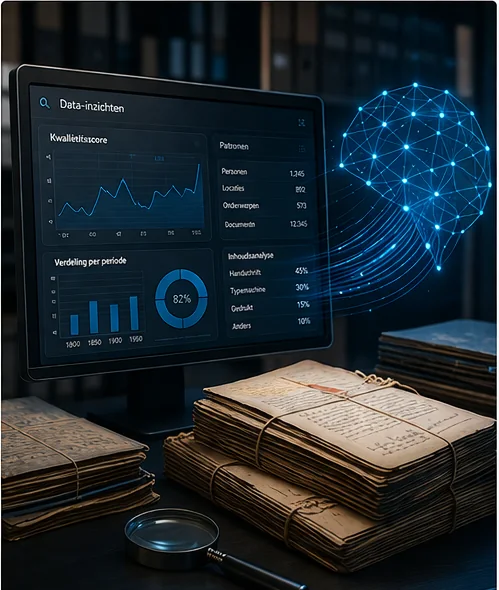
AI-ready source data

Archives and document collections only become valuable for AI when the source data is right

2dA does not digitise for the scan alone. We help organisations turn physical sources, files, books, registers, newspapers, drawings and document flows into reliable digital source data for management, retrieval, research and, where relevant, AI applications.

Preparing archival data for AI and retrieval
More than scanning

From source to usable dataset

AI needs more than separate images. Value appears with text, structure, metadata, provenance and explainable quality.

The core remains archival

AI is a later layer

The foundation remains careful digitisation, description, control and delivery. AI readiness builds on that foundation.

Why internet data is not enough

AI teams and research environments increasingly need reliable, domain-specific data. Open internet data is broad, but often lacks context, provenance, quality control and specialist depth. Archives and document collections contain exactly that depth: administrative information, historical sources, technical documentation, registers, files and meaningful collections.

That changes the question. It is not only whether documents can be digitised. The better question is whether they can be digitised in a way that makes them reliable for search, retrieval, embeddings, evaluation sets and document AI later on.

What AI-ready means here

At 2dA, AI-ready does not mean every source automatically goes into a model. It means the digital result is better prepared technically, contextually and organisationally for future use.

  • stable image quality and reliable OCR/HTR where useful
  • logical file structure, page order and document boundaries
  • metadata, provenance, rights and access status where needed
  • text and context usable for chunking, embeddings and retrieval
  • controllable delivery for research, management and AI applications
Who this serves

Not only technology companies

This route is relevant for AI teams, research institutions, digital humanities, document AI teams, knowledge organisations and public institutions that want to use their own information reliably. Organisations with unique sources have a real advantage: their data is not already available everywhere.

Why 2dA fits

Archival knowledge, digitisation and technology in one route

2dA combines archivists, restorers, scan specialists, ICT specialists and programmers. That means we do not look at data as files alone, but at the full route: material, context, quality, metadata, privacy, delivery and future use.

The chain that determines quality

AI-ready data starts with the physical material. Skew, blur, poor contrast, missing pages or unclear document boundaries later affect OCR, HTR, chunking, embeddings and retrieval. A weak capture becomes a weak information source.

That is why 2dA connects capture quality, metadata and digital delivery from the start. This matters especially for old books, registers, newspapers, large-format drawings, historical files and hybrid archives.

What the output can support

  • retrieval and semantic search across own collections
  • evaluation and benchmark sets for document AI
  • preparation for domain-specific models or workflows
  • research on historical, administrative or technical sources
  • AI-assisted metadata, classification and quality control

Rights, privacy, access status and governance always need to be considered first.

FAQ

Frequently asked questions about AI-ready archival data

Does 2dA supply training data for models?

2dA mainly helps make archives and document collections reliably digital and usable. Depending on rights, purpose and governance, that output can also be prepared for retrieval, evaluation, research or further AI applications.

Why are metadata and provenance so important?

Because AI needs more than text. Provenance, date, collection context, rights and document structure determine whether information can later be used in an explainable and reliable way.

Would you like to know whether your collection can become reliable AI-ready source data?

2dA helps determine which quality level, metadata, recognition, privacy agreements and delivery format are needed for responsible future use.