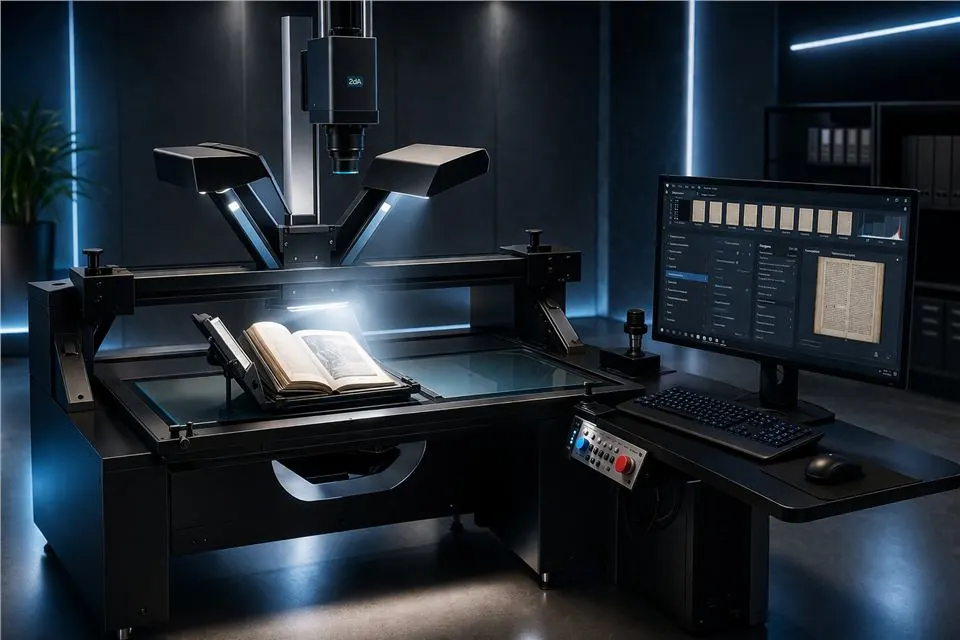
With books and registers, not only speed matters, but above all controlled opening, stable support and minimal stress on binding and spine.
Bound heritage
Digitising old books, registers and newspapers with preservation, image quality and context
Bound heritage cannot be treated like an ordinary document stream. With old books, registers, atlases and newspapers, digitisation has to do justice to preservation, readability, metadata, OCR/HTR possibilities and future use for research, management and public access at the same time.
Books and registers
Newspapers and atlases
Preservation, quality and context
Why this is different
Bound material needs different support than loose documents
Binding, spine, opening angle, paper behaviour and flatness all influence whether digitisation can be safe and reproducible. That is why the capture setup has to fit the material, not the other way around.
What matters most
Not only good images, but a digital set that truly works later on
Readability, page order, description, metadata and future use for OCR, HTR, consultation or publication all need to be part of the same route from the very start.
Old books, newspapers and atlases need detail, contrast and readability that remain usable for management, research and later recognition.
A strong capture only gains full value when page order, metadata and downstream digital usability are just as carefully organised as the image itself.
In practice
Why digitising old books is a discipline of its own
With bound heritage, digitisation quality depends on how the material is supported, how far a binding can safely be opened and how pages remain readable without unnecessary pressure or tension. That applies equally to church registers, minute books and population registers as it does to journals, atlases and newspaper collections.
That is why 2dA looks not only at capture, but at the whole combination of material, opening angle, operator workflow, quality, metadata and the question of what the digital collection needs to support later on.
Execution power
Scanner knowledge only becomes valuable when the route around the book is right
2dA works with specialist scanner environments for bound material, including setups that make calm handling, support and explainable quality possible. But the equipment is never the story by itself. The real difference only appears when selection, handling, capture, control, metadata and delivery align logically.
What kind of material this route suits best
This approach is especially relevant for collections in which binding, paper behaviour, format or historical value determine how capture should take place.
Books and serial works
Old prints, reference works, journals and serial publications need a stable route in which opening angle, support and full page registration come together.
Registers and administrative volumes
Baptism registers, population registers, minute books and other bound administrative series often need not only readable capture, but also clear structure for later searching and description.
Newspapers and large bound volumes
Newspaper bindings, large folios and atlases require extra attention to format, flatness, support and consistent capture across a full series.
Mixed heritage collections
Many institutions hold books, manuscripts, maps and loose material together. In those cases, it helps to have a route that can switch by material type without the project falling apart in content terms.
What a good book digitisation route needs to support
- support that fits the binding, spine and opening angle
- capture with stable, reproducible image quality
- checks on readability, page order and completeness
- metadata and description for registers, books and newspaper titles
- preparation for OCR, HTR or digital consultation where that adds value
- a delivery that works for management, publication and future research
That combination is what makes the difference between a scan series and a collection that remains truly usable later on.
Why quality here goes beyond sharpness alone
With old books, registers and newspapers, quality is also about consistent lighting, flatness, careful handling and a workflow that remains explainable. For heritage institutions that matters for preservation, for subsidy and quality frameworks, and for the reliability of later digital applications.
Good image quality also carries through into OCR, HTR and AI applications. When pages are captured skewed, dark or unstable, not only visual quality suffers, but also recognition quality and the value of the material for retrieval, chunking and embeddings.
Where 2dA makes the difference
2dA connects restoration knowledge, heritage capture, metadata and digital accessibility in one route. That makes it possible to digitise fragile bound collections without separating physical care for the original from the digital outcome.
For some projects this aligns with Metamorfoze-like quality requirements, for others with public access, scanning on demand or research access. In every case the core remains the same: material, quality and use have to stay in balance.
Book scanning for AI: more than a digital copy
Would you like to use books in an AI knowledge base, a search environment or a local AI assistant? 2dA helps build the foundation: carefully captured pages, text recognition and metadata that keep the text connected to the original book. Examples include reference works, technical manuals, historical publications and extensive book series.
A scan is an image. Many search and AI applications also need machine-readable text. OCR can recognise printed text; for handwriting, we assess whether HTR is appropriate. Historical typefaces, tables, footnotes and multiple columns require additional checks. Recognition and quality control therefore need to match the material and its intended use.
Answers that can be checked against their sources
A retrieval-based knowledge system, often called RAG, finds relevant passages before composing an answer. Book identifiers, chapters, page numbers and links to the scans help users find those passages and check answers. This differs from training an AI model: the model does not need to be retrained on your books for this approach. Source references enable checking, but do not guarantee error-free answers.
What do we agree with you beforehand?
- Material and volume: books, pages, formats, bindings and safe handling of fragile items.
- Purpose: searchable reading, asking questions of a collection, research or preparation for another AI application.
- Structure: page order, chapters, tables and links between recognised text and original pages.
- Quality: a representative sample, agreed checks and documented exceptions for difficult text.
- Delivery: scans, text files and metadata in agreed formats suited to your target system.
- Rights and access: what content may be made available for the intended use and who can access it. Digitisation does not automatically authorise every AI use.
For example, a library could digitise reference works so that passages can be found with references to the correct volume and page. An organisation could do the same with its own technical manuals. A representative sample provides a practical basis for planning the larger collection.
FAQ
Frequently asked questions about digitising books, registers and newspapers
Why is bound material different from loose documents?
Because binding, spine, opening angle and paper behaviour directly determine how safe and readable digitisation can be. That requires different support and a calmer capture approach.
Is this route only intended for fragile heritage?
No. Registers, larger book series and newspaper collections that mainly need to become more accessible also benefit from a route designed for bound material.
Can this be combined with OCR or HTR?
Yes. Especially with books, registers and newspapers, image quality matters for later recognition. That is why we look not only at capture, but also at digital usability afterwards.
Does everything have to fit one fixed scanner setup?
No. The right route is determined per material type and collection. Specialist setups help where bound material genuinely requires them.
Would you like to digitise old books, registers or newspapers in a way that works for preservation and use?
We are happy to think with you about material type, quality level, metadata, OCR or HTR and the way the collection needs to be managed, researched or consulted later on.