Not just digitising, but also knowing what comes in, where it needs to go and what its status is.
Digital mailroom
Digitise inbound mail as a workable digital mailroom instead of a loose scanning task
For many organisations, inbound mail is still an operational bottleneck. Not because a letter cannot be scanned, but because the real pressure sits around registration, routing, status handling, prioritisation, exceptions, quality control and digital delivery into the right internal or external environment. That is exactly where a digital mailroom makes the difference.
2dA helps organisations approach mail digitisation not as a loose action, but as a service in which intake, processing, integrations and feedback are logically connected. The physical mail scanning itself takes place at 2dA in Nijmegen in the scanning street. That makes inbound mail available faster, more traceable and less dependent on ad hoc inboxes, manual lists or individual knowledge inside teams.
For organisations that want to organise this formally as records replacement or substitution, the route can also be prepared for that purpose. Especially with inbound mail, this often fits a routine replacement process: not managing paper and digital side by side any longer than necessary, but working towards a digital mailroom that is also stronger from a governance and legal perspective. The formal decision always remains with the organisation itself; 2dA supports the practical execution underneath it.
Inbound mailDigital mailroomNijmegen scanning streetSubstitution ready
Why this matters now
Mail flows need to move through digital processes faster
Especially in municipalities, public bodies, archive services and other document-intensive environments, the question is no longer whether mail should be processed digitally, but how to do so without losing grip, status and delivery reliability.
What 2dA adds
Not only scanning, but route, platform and delivery
2dA scans mail in the scanning street in Nijmegen and connects that production to workflow, routing, quality control, metadata and delivery. That is what allows a digital mailroom to fit the daily reality of service desks, departments, back office teams and citizen service.
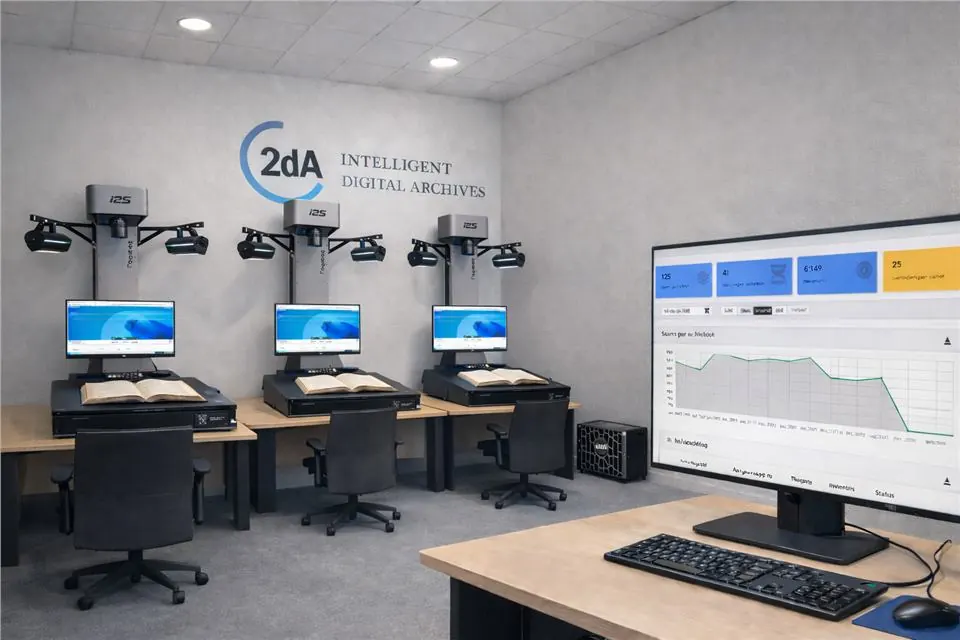
The physical mail scanning takes place at 2dA in Nijmegen in the scanning street, where production and quality control come together.
Where the organisation has formally arranged it, inbound mail can also be prepared as a route for records replacement or substitution.
What a digital mailroom needs to support in practice
- register and prioritise incoming mail
- digitise physical post quickly in the scanning street in Nijmegen
- route documents to the right department or handler
- maintain status information and logging
- handle exceptions and quality control
- support digital delivery into internal and external systems
- support a route that, where formally required, can also be used for records replacement or substitution
Why scanning alone is not enough
Many organisations can technically scan mail already. The real issue often starts afterwards: which mail gets priority, how context is preserved, how items are distributed, how they return to the right handler and how peak pressure is controlled. That is where mail digitisation becomes a process question rather than a stand-alone scanning question.
That is also why this route matters for records replacement or substitution. If an organisation wants digital processing to become the leading route, image quality, quality control, logging, metadata and digital delivery all have to hold up. Otherwise paper changes form, but not really process.
Records replacement or substitution demands more than a good scan
When an organisation wants inbound mail to land in a formal replacement route, the whole chain has to be explainable and controllable. That means not only making scans, but also documenting the process, quality control, logging, metadata, exceptions and the way digital reproductions return into the workflow.
2dA supports exactly that practical layer. Not by taking over the organisation's formal decision, but by making sure the execution beneath it is arranged properly. That makes a digital mailroom not only faster, but also more consistent and more sustainable in practice.
What this delivers in practice
The main gain is that paper and digital no longer have to hang next to one another unnecessarily. Incoming mail is processed faster, digital files are built more calmly and internal teams get a route that depends less on manual hand-offs.
- less double management of paper and digital
- faster availability for case handlers and teams
- better explainability for audit, governance and service delivery
- a stronger foundation for further digital delivery and workflow automation
In-house platform
2dA supports the digital mailroom with a fully in-house developed software platform
The platform supports not only scanning, but also intake, prioritisation, status handling, logging, quality control, feedback and digital delivery. Because 2dA develops this layer entirely in-house, the solution can be aligned far more precisely to the customer's working practice than a generic package can.
Clear division of roles
Scanning in Nijmegen, digital handling connected logically
The physical mail scanning takes place at 2dA in Nijmegen in the scanning street. The software platform then supports intake, routing, status, logging, quality control and digital delivery, so the result returns cleanly into the client's working practice.
Who this is especially relevant for
- municipalities and public bodies with large incoming mail and document flows
- organisations with citizen contact, front-office processes or service desks
- environments where physical mail has to become digitally available quickly via the Nijmegen scanning street
- teams that want to absorb peaks without building structural excess capacity
- document-intensive organisations that want better routing, tracking and digital delivery
- organisations that also want inbound mail to support records replacement or substitution
How 2dA positions this
Not as generic mail processing, but as a route in which scanning, content, status and digital hand-off come together. That is exactly why this proposition fits well with scanning on demand, the in-house software platform and sectors such as municipalities, archives and other information-intensive organisations.
Once records replacement or substitution enters the picture, this becomes even more important. The route then has to be not only fast, but also controllable, explainable and stable in daily use. That is where the combination of scanning street, workflow, quality control and digital delivery makes the difference.
FAQ
Frequently asked questions about mail digitisation and the digital mailroom
Is this only relevant for municipalities?
No. Municipalities are a clear use case, but any organisation with inbound mail flows, routing pressure and digital delivery can benefit from this.
Where does the physical mail scanning take place?
The physical mail scanning takes place at 2dA in Nijmegen in the scanning street.
Can this route also support records replacement or substitution?
Yes, where an organisation has formally arranged that route. 2dA then supports the practical layer, such as scanning, quality control, logging, metadata and digital delivery. The formal decision remains with the organisation itself.
Why is the software layer so important here?
Because intake, routing, status handling and delivery are what determine whether a digital mailroom remains calm and professional in daily practice.
Related routes
Continue on these pages
Do you want to digitise mail as a real service instead of loose scanning work?
2dA helps set up your digital mailroom so that scanning, routing, status handling and delivery work better for internal teams and for users outside the organisation, and where needed can also fit into a formal replacement route.