The bulk flow is divided logically by archive segment, file series, format or use case so that preparation, scanning and control reinforce each other.
Bulk digitisation
Bulk digitisation with process control, quality and usable output
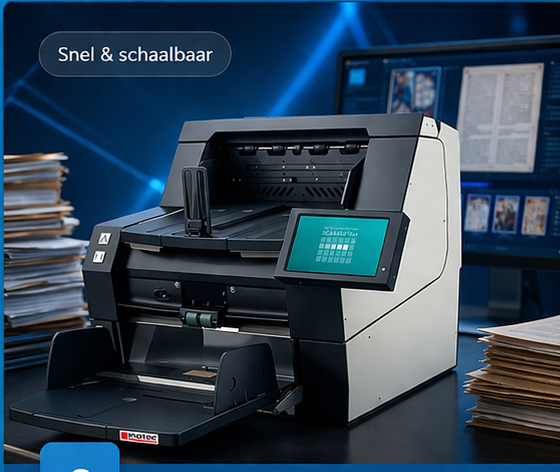
Large volumes have to move fast, but without losing control over exceptions, metadata and the digital output that people will actually use afterwards. 2dA works with scalable scanning lines and a production environment designed for long-running, repeatable processing of large archive, file and document flows.
Especially with larger series, bulk digitisation can also be prepared as a project-based route for records replacement or substitution. That means not only moving volume, but designing a route in which digital reproductions, quality control, metadata and delivery are strong enough to support a digitally leading process later on. The formal decision remains with the organisation itself; 2dA supports the practical setup underneath it.
Scaled processScalable scanning linesQuality controlWorkable deliveryProject-based replacement
Why this matters
Large volumes require control, not just capacity
In large projects there are always unusual formats, incomplete files, privacy-sensitive records, logistical interruptions and differences in description or retention logic. That is why 2dA combines production capacity with content control: without that combination, production may look high while output quality drops.
What it aims for
Not only scanning quickly, but delivering material that is immediately usable
2dA designs bulk projects so that files, metadata and digital structure align with management, consultation, scanning on demand, storage logic and other follow-up processes.
Oversize material, fragile items, privacy cases and technically unusual sets are not pushed into the standard stream.
File naming, metadata and digital structure are designed for the systems, teams and request processes that will actually use them later.
Where formally arranged, bulk can also be prepared as a route for records replacement or substitution.
In practice
Not just production volume, but keeping bulk manageable
A strong bulk project depends on process discipline. Not as bureaucracy, but as the way to keep large volumes manageable without losing quality, context or overview.
2dA connects intake, segmentation, preparation, scanning, quality control and delivery in one executable line so that speed and content control stay aligned. Its scanning lines are set up for serial production, peak load and repeatable quality, not only for incidental scanning.
Execution power
Bulk projects that do not end with the last box
The real value of bulk digitisation appears afterwards: can staff find files immediately, does the output fit working agreements and can follow-up processes continue without repair rounds?
That is why 2dA delivers bulk projects not only quickly, but also logically, controllably and ready for direct use in management and service delivery.
With bulk, records replacement often becomes a project question
With inbound mail, replacement often fits a routine flow. With large archive blocks, file series and administrative volumes, it becomes more of a project-based route. That means it has to be clear in advance how segmentation, image quality, quality control, metadata and logging are arranged.
2dA supports exactly that execution layer. Not by taking over the formal decision, but by making sure the bulk project is strong enough in content and operations to connect to it properly.
Why that makes such a difference
When a bulk project is prepared properly for records replacement or substitution, it creates more than a digital copy. It creates an information process in which paper no longer has to keep circulating next to digital unnecessarily and in which teams can move forward faster with a controlled digital basis.
- less double management of physical and digital series
- faster availability for management, retrieval and daily execution
- a stronger basis for metadata, delivery and follow-up services
- more calm in large digitisation projects under administrative or legal pressure
How 2dA organises a bulk project that stays stable as well as fast
A strong bulk project is not driven by speed alone. Intake, logistics, quality control and metadata all have to fit into one executable line.
That is why a bulk project at 2dA includes, among other things:
- intake and segmentation by archive segment, file series, box, period, format or use case
- preparation and logistics that keep return, provenance and processing clear
- scanning and production control with room for quality checks and exception routes
- quality control on image quality, completeness, order and file creation
- metadata and file structure that support later retrieval
- delivery for the system, storage process or workflow the organisation must continue with immediately
For archive series, collections and administrations that must become usable again at scale
Bulk digitisation is most relevant when an organisation needs to make not individual documents, but whole flows or series available in a controlled digital form.
Complete archives
For archive segments that need to become digitally available in one route for management, research or wider access.
Administrative series
For organisations that need to process large numbers of similar documents under fixed output requirements.
Corporate archives
For environments where daily usability, control, retention and quick internal access all matter heavily.
Hybrid routes
For projects in which central production is combined with on-site digitisation, customer scanners or scanning on demand.
Immediately usable, not only after an extra project
The real value of bulk digitisation is not the moment the last box has been processed, but what happens afterwards. Can staff find files straight away? Does naming fit existing working agreements? Have metadata, exceptions and privacy cases been handled properly? Can the organisation move on to scanning on demand, storage management or a new digital service?
2dA therefore designs bulk projects so the digital result does not first have to be repaired. That saves time, prevents rework and makes the investment far stronger in practice.
- consistent output for management and consultation
- clear structure for series, files and exceptions
- alignment with metadata, anonymisation and follow-up processes
- a scalable basis for later services
Why bulk digitisation should not be treated as a stand-alone production project
A good bulk route must not only process a lot, but also keep working logically for people, systems and follow-up steps. That is why 2dA connects production, quality control, metadata and delivery in one clear execution line.
This makes bulk digitisation not a separate production job, but a controlled digital restructuring of large document flows.
Related routes that keep bulk working afterwards
Scanning on demand as a follow-up service
When targeted requests or additional selections remain necessary after bulk digitisation, 2dA can connect a scanning-on-demand route directly to the result.
Metadata and access
Large volumes only stay useful when structure, fields and findability are properly organised. That is why metadata is not an attachment, but a core part of bulk.
Follow-up applications for specific environments
Corporate archive digitisation
For organisations where bulk digitisation goes together with retention schedules, controllability, fast internal consultation and operational workflows.
On-site or hybrid digitisation
Some bulk projects require execution in the client's own environment or in combination with existing scanners and teams. 2dA supports that route as well.
FAQ
Frequently asked questions about bulk digitisation
When is bulk digitisation smarter than scanning on demand?
When complete series, archives or large file flows need to become structurally available in digital form, bulk is the most logical basis. Scanning on demand fits better with separate, changing requests.
Can bulk be combined with privacy-sensitive information?
Yes. The workflow then has to be designed for it explicitly, for example with segmentation, exception routes, metadata agreements and links to anonymisation.
What if the material is not fully uniform?
That is more the rule than the exception. This is exactly why 2dA works with segmentation and separate treatment of unusual formats, file structures and material types.
Can bulk also be set up for records replacement or substitution?
Yes, where an organisation formally wants and can organise that route. 2dA then supports the practical layer, such as segmentation, scanning, quality control, metadata, logging and digital delivery. The formal decision remains with the organisation itself.
Can a bulk project later grow into other services?
Yes. Think of scanning on demand, metadata enrichment, storage management, AI support or operation within a customer-owned scanning environment.
Coherence
Related routes
Bulk digitisation at 2dA does not stand alone. This page connects directly to services that strengthen the same information chain.
Would you like to design a large digitisation route properly from the start?
We are happy to look with you at volumes, material types, exceptions, metadata, privacy, logistics and the digital delivery your organisation actually needs afterwards, including whether project-based replacement is a logical route.
Why this works
A strong bulk route pays back in every follow-up step
From management and consultation to scanning on demand, metadata, storage processes and new digital services: the better the bulk output is designed, the stronger the whole information chain performs.