Not ad hoc scanning whenever someone asks, but a route in which speed goes together with control, prioritisation and traceability.
Scanning on demand
Scanning on demand for archive services, FOI pressure, citizen requests and internal retrieval
For municipalities, archive services and other document-heavy organisations, scanning on demand is rarely just about speed. It is about a route in which requests stay traceable, material is found quickly, quality remains explainable and digital delivery fits citizen service, internal handling, reading-room requests, administrative pressure or freedom-of-information related questions.
2dA helps turn separate scan requests into a manageable service. This can be fully outsourced, organised in a hybrid setup or used to strengthen an existing scanning environment. Especially where public service, archival practice and information management meet, scanning on demand for an archive service or municipality makes the difference between incidental handwork and a professional service.
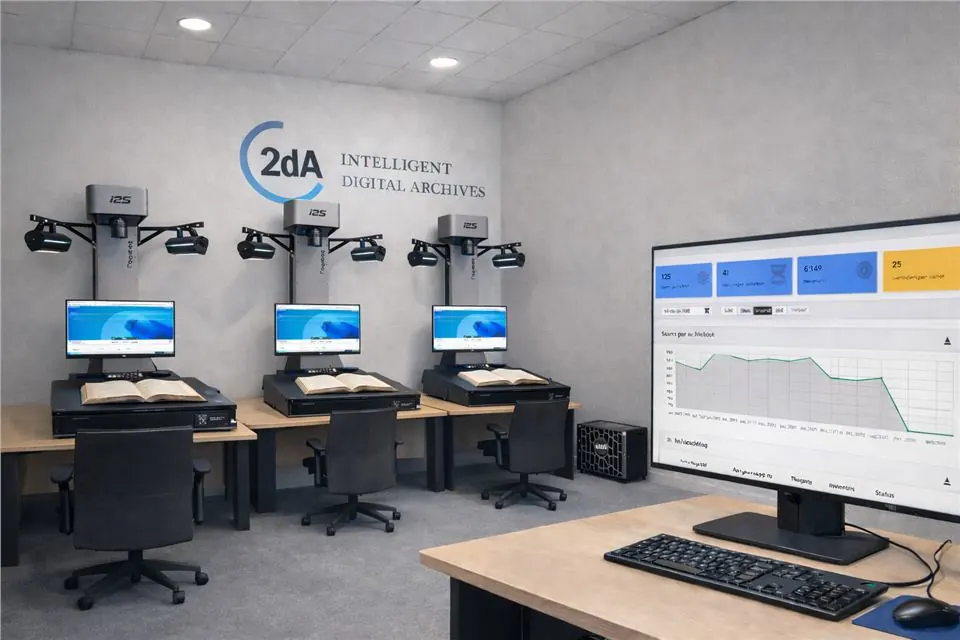
2dA also works with its own software platform, developed fully in-house. That matters for clients because the route does not have to be forced into a generic package: intake, prioritisation, logging, status tracking, quality control, delivery and feedback can be aligned to the real workflow of the organisation.
The platform can run fully inside the client environment, but it can also be organised as a hybrid model so 2dA can help absorb peak hours and peak days without leaving the full pressure of delivery to citizens, customers or internal users on the organisation alone. That gives clients a service that feels more robust, more adaptable and more professional from the start.
Citizen and FOI-related requestsArchive services and reading roomInternal retrieval workflows
Where it matters
Not digitising everything, but delivering exactly what is needed now
Scanning on demand is strongest when documents must be delivered in a targeted way: a file for a citizen, a set of documents for an information request, a scan for the reading room or an internal request that cannot wait for a larger digitisation project.
2dA approach
From request and selection to scanning, checking and digital delivery
2dA looks beyond capture alone. We focus on request logic, selection, exceptions, privacy, metadata, quality control, OCR or HTR where searchability or handwriting require it, turnaround time and how digital delivery comes back into the workflow.
Where information requests, citizen service, reading-room work and internal retrieval meet, scanning on demand becomes a strategic service instead of a loose task.
What begins as a scan-on-request route can grow into a digital desk, public service channel or linked request service with metadata, feedback and workflow support.
Where municipalities notice the value immediately
Freedom-of-information and document requests
Where documents must move quickly out of physical files or hybrid archives, scanning on demand helps make the step to digital delivery shorter, calmer and easier to organise.
Citizen requests and public service
Citizens increasingly expect digital availability. A fixed scan-on-request route makes service more consistent and less dependent on individual knowledge or ad hoc capacity.
Internal handling and administrative pressure
Within permits, objections, enforcement, project files and administrative review there are many moments when documents must become digitally available fast, without launching a full bulk programme.
Where archive institutions notice the gains
Reading-room and reproduction requests
Not every item has to be digitised in advance. With scanning on demand, documents can be made digitally available in a targeted way for researchers and visitors while reducing physical strain on the collection.
Digital public service
A good on-demand route makes it easier to connect forms, feedback, prioritisation and delivery to public-facing service.
Fragile or exceptional material
When material is not standard scan-safe, restorers, archivists and scanning specialists can assess together which safe route is required and how delivery can still move forward.
In-house software platform
Not only a scanning route, but a platform that supports the full service
2dA works with its own software platform, developed fully in-house, that makes scanning on demand operationally manageable. Requests, priorities, statuses, exceptions, logging, quality control and delivery can all be supported in one line instead of being spread across separate inboxes, lists and manual follow-up.
For clients, that means more than control alone: it means a service that fits their process better, can be adapted faster and feels more professional to citizens, researchers, customers and internal users.
Fully local or hybrid
The platform can run fully on-site, or flex in a hybrid model
In some environments everything has to stay inside the organisation. That is possible. In other situations a hybrid model is stronger: the client keeps the environment and governance, while 2dA helps during peak periods with processing, quality control or delivery. That keeps service to citizens or other requesters running without overloading internal teams.
This combination of in-house developed software, hybrid support and execution capacity is what makes scanning on demand scalable without becoming bureaucratic or fragile. To a client, that feels like a partner who can actually adapt when practice changes.
Why it matters now
The pressure is not only on digitisation, but on direct availability
In practice, organisations need to deliver documents faster without forcing employees to improvise every time. That applies to internal retrieval, external requests, public service and processes in which physical documents still exist but digital delivery becomes the preferred route.
For municipalities this touches FOI-related pressure, citizen service and administrative turnaround. For archive institutions it often means reading-room requests, digital public service, reproduction on request and the wish to put less physical strain on fragile material.
Scanning on demand is therefore not only a scan service, but also a way to organise access, service and workload more intelligently.
What a good route does
A good scanning-on-demand service makes the whole chain calmer
When selection, retrieval, scanning, quality control, file naming, metadata and delivery align logically, there is less searching, less repetition and less dependence on individual knowledge. That makes the service more scalable and more explainable to users, colleagues and management.
This is exactly where scanning on demand becomes strategic: not just a way to make scans, but a service layer that makes information available faster without losing care or explainability.
Which organisations benefit most from this route
- municipalities and public bodies with document requests, citizen service and freedom-of-information related pressure
- regional archives and archive services with reading-room, public and scan-on-request activity
- organisations with large file environments where specific documents must quickly become digitally available
- client environments with an existing scan line or service desk that need strengthening
- collections where not everything needs to be digitised at once, but access must work right now
For complete series or large volumes, bulk digitisation usually remains the more logical choice. Beneath that, in the daily stream of targeted requests, scanning on demand proves its value.
Three ways in which 2dA can help
Fully outsourced
2dA handles requests, material selection, scanning, quality control and digital delivery as a complete service.
Hybrid collaboration
Your organisation keeps parts of the request or desk process in-house, while 2dA takes over scanning, quality control, metadata, delivery or exception handling. The 2dA platform helps support that collaboration in one service flow.
Strengthening your own environment
If scanners, software or service processes already exist, 2dA helps improve and further develop that route, including links to the platform, internal systems and external delivery.
What scanning on demand connects to in practice
- freedom-of-information and document requests in which files must be found and delivered quickly
- citizen service and request workflows where turnaround time is directly visible
- reading-room, reproduction and digital public service routes
- internal handling of files, permits, building records and administrative series
- privacy-sensitive material where selection, redaction support and controlled delivery matter
That is why 2dA links scanning on demand where needed to metadata, privacy, OCR, HTR for handwritten pages, scanners and platform support, digital service and further process improvement. The scan itself is then not the end goal, but the means to get the right information to citizens, researchers, colleagues and administrators faster, with an in-house developed platform that can support delivery to internal and external systems.
Why 2dA is strong in this area
2dA combines execution with subject-matter expertise. Archivists and junior archivists help keep the route logical for file structure, context and retrieval. Restorers assess fragile or unusual material. ICT specialists and programmers develop the software, links and workflow support fully in-house so technology stays aligned with practice.
This is what keeps scanning on demand from becoming only a production line or only a policy ambition. It becomes a service that can handle substance, process and technology at the same time, with less dependence on rigid third-party software or disconnected suppliers.
- substantive assessment and process knowledge in one team
- in-house scan lines and on-site support
- experience with metadata, digital access and file environments
- room to start small and scale up in a focused way
Deepening
For municipalities and archive institutions there is more going on than just a scan request
Anyone working with information requests, citizen service, reading-room requests or internal retrieval quickly sees that scanning on demand is really a service question. That is why we created a separate page with more focus on process design, public service and archival practice.
Read how scanning on demand works for municipalities and archive institutions
Would you like to know how scanning on demand becomes workable inside your organisation?
2dA helps turn separate requests into a manageable route that fits your material, your workflow and the expectations of users, citizens or researchers.
Why this works
Scanning on demand only becomes strong when request, scanning and delivery are designed as one service
That is exactly where 2dA helps: not only with scan production, but with a route that creates calm in handling, remains explainable to users and can grow with municipal, archival and file-based practice.