Without metadata, a great deal of information may exist, but it cannot truly be retrieved.
Metadata and access
Adding metadata to scans is what makes digitisation truly usable
Many organisations rightly invest in digitisation, but then notice that information is still hard to find. In most cases, the problem is not the scan itself, but the lack of structure, metadata and access. 2dA helps make adding metadata to scans part of the trajectory from the very beginning.
Recognition is part of that layer as well. OCR is used to make printed text machine-readable. HTR is used for handwriting. Both are not just technical add-ons afterwards, but substantive steps that strongly influence how searchable, usable and AI-ready a digital collection will be later on.
Structure and metadataOCR and enrichmentFindable use
What metadata solves
Make relationships visible
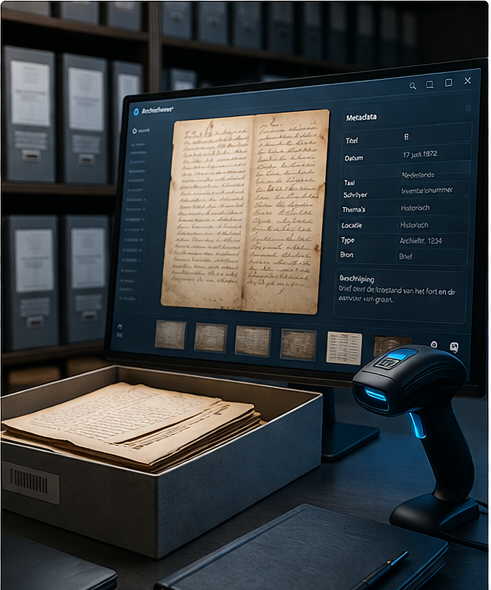
Metadata makes clear what something is, where it belongs, how it relates to other records and how it can be found later.
Enrichment
Only use OCR and HTR where they truly add value
OCR makes printed text machine-readable. HTR does the same for handwriting. That is what turns scans from visible images into material that can be searched, analysed and reused much more effectively in access, research and later AI applications.
The search questions of staff, researchers and users determine what the access layer needs to look like.
This layer is also decisive for retrieval, semantic search and AI-ready data.
In practice
The scan is only the beginning of a usable digital collection
2dA develops metadata and access not in isolation, but in direct relation to management, research, services or public use.
Why this matters
Findability usually fails not on image quality, but on structure
Without good description, consistent fields and logical context, you quickly end up with a digital environment in which a lot exists, but little comes back in a truly usable way.
What 2dA adds here
- naming, fields and file structure
- logical ordering and access
- adding metadata to scans based on real usage questions
- OCR, HTR and enrichment where they truly help
- better alignment with systems and search environments
- preparation for AI and semantic applications
Why this layer is often underestimated
Metadata sometimes looks like an extra layer added afterwards, but in reality it is the link between digitising and actually using information.
Why image quality matters so much for OCR and HTR
Reliable recognition does not begin in software alone, but in capture quality. Skew, blur, low resolution, weak contrast, uneven lighting, show-through, folds or noisy backgrounds all reduce the chance of accurate text recognition. That applies to OCR on printed text, but even more strongly to HTR on handwriting.
That is why 2dA does not treat recognition as a purely technical step afterwards. We look at capture logic, image quality, material preparation and the level of quality required if the text is meant to be reused seriously later on.
Why this also matters for later AI applications
AI applications on documents often build on recognised text. When OCR or HTR is weak, you end up with noise, broken sentences and incorrect words. That directly affects chunking, semantic findability and embeddings. Poor source quality then leads not only to worse search, but also to weaker AI answers and less reliable links between records.
That is exactly why 2dA does not separate image quality, recognition, metadata and AI. Strong capture produces better recognition. Better recognition produces better chunks and embeddings. And those in turn form the basis for retrieval, semantic search and AI on your own data.
FAQ
Frequently asked questions about metadata and access
Is metadata only for administrators?
No. Good metadata also helps end users find what they need faster and more precisely.
When should metadata be added to scans?
As soon as information later needs to be found by file, address, person, period, topic, document type or provenance. Metadata determines whether scans become genuinely usable.
When does OCR really add value?
When users later want to search, filter or analyse content faster instead of only browsing through scans.
Do you want to make digital collections easier to find and use?
2dA helps you organise metadata, OCR, enrichment and access in a way that makes digitisation truly work in practice.
Why this works
Metadata turns isolated scans into a workable information source
By connecting structure, OCR and enrichment directly to real usage questions, 2dA helps organisations make digital collections much stronger in content and usability.