Where documents must move quickly from physical file to digital delivery, scanning on demand helps make that route manageable.
Municipalities and archive services
Scanning on demand for FOI-related pressure, citizen requests, reading-room work and internal retrieval
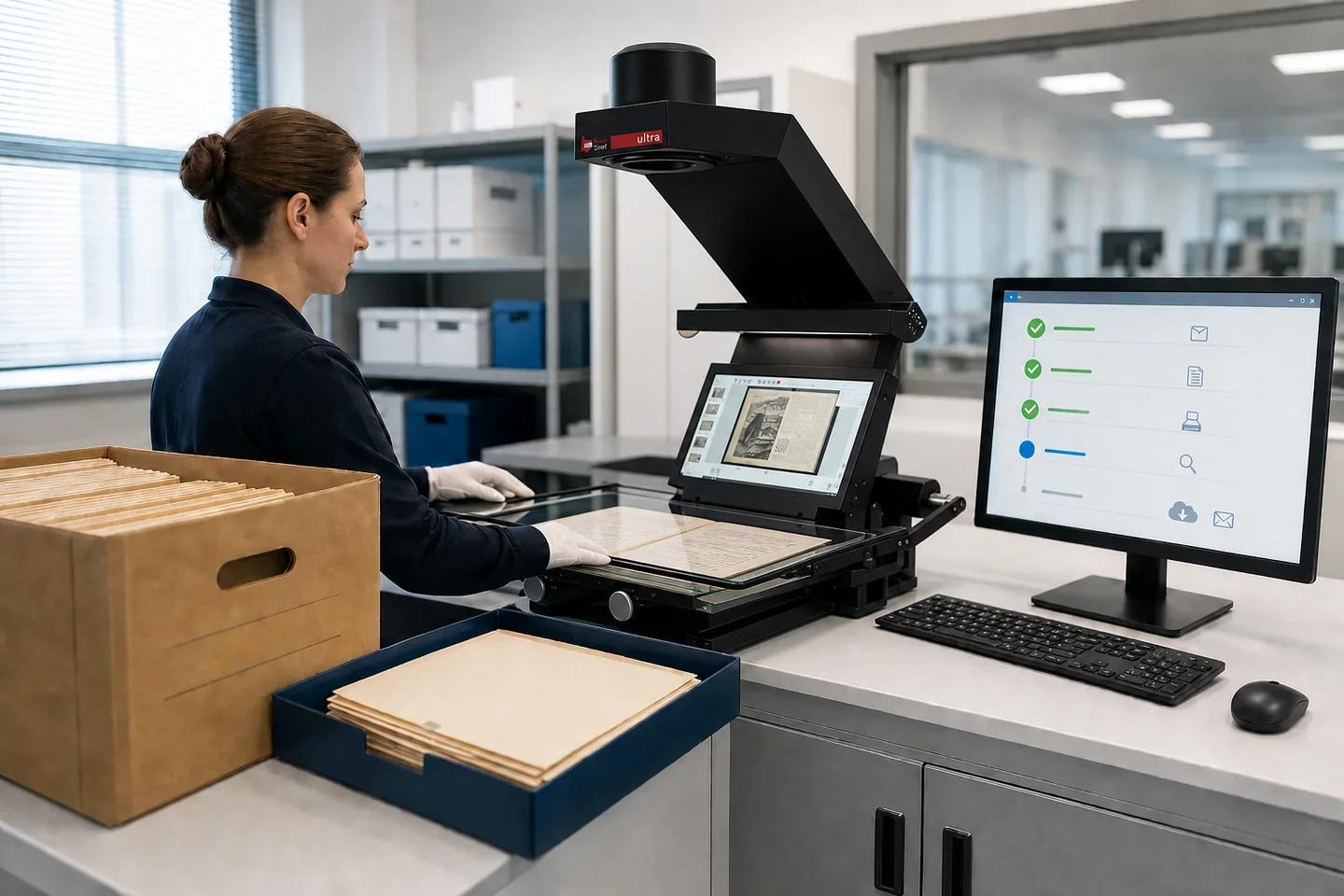
For municipalities and archive services, scanning on demand is not only about digitising a document on request. It is about building a service that makes information available faster, reduces physical handling and remains careful enough for public service, administrative accountability and archival practice.
This is where 2dA fits in: as a partner that can align request logic, material handling, scan production, metadata, quality control and digital delivery in one line.
2dA also adds its own software platform, developed fully in-house. That matters for clients because the service does not have to be forced into a generic package: intake, prioritisation, status tracking, logging, quality control, delivery and feedback can be aligned to the actual workflow of a municipality or archive service.
The platform can run fully inside the client environment, but it can also be organised as a hybrid setup so 2dA can help absorb peak hours and peak days. That gives clients more control, less improvisation and a service that remains professional under pressure.
Citizen and FOI-related pressureReading room and public serviceWorkable scan service
Why this matters now
The pressure is on availability
More information requests, higher expectations of digital service and growing pressure on information management make it difficult to keep handling physical documents ad hoc. A well-designed scanning route helps build speed and care at the same time.
What 2dA adds
Not only scan production, but a working service
2dA looks at the incoming flow of requests, how material is located, how priority is set, how exceptions are handled, which metadata travels along and how delivery is fed back. That makes scanning on demand an explainable service instead of a collection of rushed manual steps. The in-house platform helps make that route technically and operationally complete, and easier to adapt when practice changes.
For citizen requests, reading-room scans and reproductions, a fixed route makes the difference between incidental handwork and a reliable service.
A strong scan-on-request route reduces searching, reduces duplicated effort and makes responsibilities clearer across desk, archive and back office.
Where municipalities gain concrete value
Freedom-of-information and document requests
When documents need to be located, selected and delivered digitally at pace, scanning on demand helps shorten and organise the step from physical archive to digital delivery.
Citizen service and retrieval workflows
Cities increasingly need to serve citizens digitally. A fixed request and scanning route makes service more consistent and less dependent on individual knowledge.
Internal handling
Within permits, objections, enforcement or project files, there are many moments when documents must become digitally available fast for colleagues without launching a full bulk digitisation programme.
Where archive institutions notice the gains
Reading-room and reproduction requests
Not every item has to be digitised in advance. With scanning on demand, documents can be made digitally available in a targeted way for researchers and visitors while reducing physical strain on the collection.
Digital public service
A good on-demand route makes it easier to connect digital delivery to public service, request forms, feedback and prioritisation.
Fragile or exceptional material
When material is not standard scan-safe, restorers, archivists and scanning specialists can assess together which safe route is required.
Process design
A good on-demand service is more than a scanner
In practice it must be clear how requests enter, how material is located, who sets priority, how exceptions are handled, which metadata travels along and how digital delivery is reported back. That is where the real quality of the service lives.
- request intake and triage
- locating and selecting material
- review of privacy, restrictions and material condition
- capture and quality control
- digital delivery, logging and feedback
Why 2dA fits
2dA can carry substance, execution and technology at the same time
Archivists and junior archivists help keep the route logical for file structure, context and retrieval. Restorers step in where material is fragile or exceptional. ICT specialists and programmers help where links, software, scan support or feedback are needed. This keeps the process from getting stuck in production alone or policy alone.
Platform layer
The service does not stop at scanning, but continues through delivery
The 2dA platform supports not only production, but everything around it: intake, triage, tracking, quality control, status information and delivery to citizens, public service channels, internal systems or other external environments. Because 2dA develops this software fully in-house, the service can be aligned much more closely with how your organisation actually works.
Absorbing peaks
Hybrid working makes peak pressure manageable
When pressure rises temporarily, the organisation does not have to absorb everything alone. The platform can be set up so the route keeps running inside the client environment while 2dA helps during peak days or peak hours with processing, quality control or delivery. That keeps service levels to citizens, visitors or internal requesters stable without exhausting the internal team.
What organisations notice in practice
- faster and more consistently explainable digital delivery
- fewer separate rush actions in archive or back office
- better alignment between public service and archival practice
- more control over quality, priority and turnaround time
- a stronger base for scaling into a structural digital service
That makes scanning on demand not only a practical answer for today, but also a growth path towards better organised digital access.
Where 2dA can flex with you
- fully outsourced scanning on demand
- support for an existing scan environment or public desk process
- temporary reinforcement during peaks or backlogs
- quality control and process improvement
- growth into digital forms, paid service or linked feedback
That flexibility matters in municipal and archival practice, where volume, urgency and exceptions are not always predictable. With the combination of an in-house platform and hybrid support, 2dA can flex without making the route harder to manage or tying the organisation to rigid outside software.
FAQ
Frequently asked questions about scanning on demand in these sectors
Is scanning on demand the same as FOI handling?
No. Scanning on demand is not a legal process, but a practical service that helps make documents digitally available faster within a carefully designed route.
Can this run next to an existing scan line or desk process?
Yes. 2dA can strengthen an existing environment instead of replacing it, for example with quality control, process design, exception handling or temporary capacity.
Is this only useful for external requests?
No. Internal retrieval, administrative treatment, permit files and staff use of archives also benefit from a better digital request route.
Would you like to use scanning on demand more intelligently for your municipality or archive institution?
2dA helps turn document requests, citizen retrieval, reading-room work or internal scans into a service that works faster, more clearly and at a better scale.