Heritage digitisation begins not at the scanner, but with the material, condition and intended use of the collection.
Heritage digitisation
Heritage digitisation for preservation, context and public reach
Heritage digitisation requires more than image quality alone. The combination of condition, context, description and future use determines whether a digital collection truly gains value.
Preservation and captureMetadata and contextPublic and management use
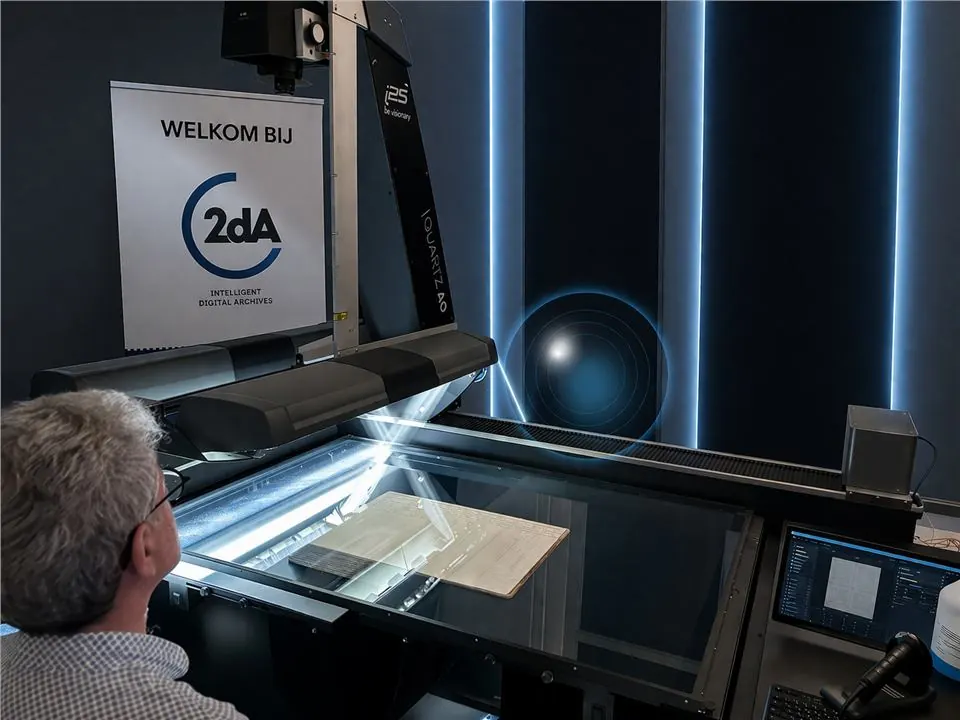
Why this matters
Not only capture, but making collections sustainably usable
Heritage collections involve more questions than resolution or sharpness alone. Think of condition, light exposure, order, context, metadata and the way a collection will later be managed, researched or published.
What it aims for
A digital collection that fits management, research and public use
2dA connects preparation, capture, description and access in one route, so that the digital outcome not only looks good, but also aligns logically with internal management and public use.
Capture, metadata, description and structure must move together so that a collection can later truly be found and understood.
The digital collection has to work for staff, researchers, depot logic and public access, not only for the moment of capture.
In practice
Why heritage digitisation requires extra care
Heritage collections raise more issues than image quality alone. Think of material tension, light exposure, flatness, order, description, publication quality, preservation files and the way a collection remains findable later on.
That is why 2dA starts not with the scanner, but with what your collection needs to become safely, consistently and sustainably usable in digital form. Even with larger heritage series, the route stays focused on controlled production: enough capacity to move forward, while preserving material care, sequence, metadata and quality control.
Execution power
Technology and collection knowledge in one route
In heritage digitisation, restoration, stabilisation, capture, description and access are not organised separately, but viewed together. This helps keep the route calmer and the digital result better aligned with management, research and public use.
The result is not a loose scan series, but a digital collection that continues to work logically in practice. By combining specialist heritage knowledge with scalable production, 2dA can process both unique items and larger collection flows in a controlled way.
Collections for which this approach is suitable
This way of working is well suited to collections in which material behaviour, historical context and digital usability all require attention. That ranges from tightly structured series to unique pieces with unusual formats or fragile bindings.
Books and registers
Bound material requires capture without unnecessary stress on binding, spine and paper. Opening angle, support, readability and complete registration of page structure all matter.
Manuscripts and archival materials
Loose documents, files, deeds and manuscripts often require a combination of careful handling, clear sequence, material assessment and good descriptive logic.
Maps, plans and oversize material
For large-format heritage material, flatness, support, tension distribution and scan safety play a much larger role. Here digitisation directly touches restoration practice.
Special items and mixed collections
Not every collection fits within one production line. Sometimes it is precisely the mix of formats, carriers and condition differences that determines a smart and realistic approach.
How a heritage project is built step by step
A heritage route works best when not only the capture itself, but also preparation, description and the eventual link to management or public use are considered from the start.
- collection analysis of material types, formats, risks, quality requirements and use scenarios
- condition assessment and preparation, possibly in connection with restoration or stabilisation
- capture and quality control aligned with colour, sharpness, flatness, file format and later use
- metadata and context for naming, structure, identification and descriptive logic
- delivery for the system, portal or workflow in which the collection must land
- follow-up use for scanning on demand, enrichment, publication and depot relief
Quality means more than sharp images alone
In heritage work, quality is not only about resolution, but also about reproducibility, consistent workflow, careful handling of fragile material and the question whether digital files will remain reliable for later use. Formal heritage digitisation frameworks therefore put strong emphasis on sustainable quality and usability.
When a project has to meet high quality frameworks, Metamorfoze-like requirements or a public and management setting in which context leads, we design capture, control and delivery around that from the start.
- quality is defined beforehand rather than assessed afterwards
- metadata and structure are treated as core elements of the route
- fragile originals get a route that fits their physical condition
- the digital result is designed for lasting use, not only production volume
A route in which preservation, capture and use stay aligned
Many heritage institutions are not only looking for a party that can capture material, but for an approach in which condition, quality, planning, risks and digital usability remain in balance. That is why 2dA looks at the whole route, from preparation to the way the collection will later be used and found again.
For many institutions it is important that heritage digitisation does not stop at capture itself, but continues into description, storage, consultation and digital visibility.
- an in-house production environment for fragile material, series and hybrid routes
- a strong link between restoration, capture, metadata and digital access
- a route to use for public reach, management, research and retrieval
Related routes that strengthen heritage digitisation
Books, registers and newspaper collections
With bound heritage material, image quality is only part of the story. Opening angle, support, page order and later consultation matter just as much. That is why 2dA has a dedicated route for this within heritage digitisation.
Go to books, registers and newspapers digitisation
Restoration and preparatory treatment
When material is too brittle, distorted or unstable for direct capture, heritage digitisation at 2dA can connect directly to the restoration studio. This makes preservation part of the same route instead of a separate preliminary stage.
Metadata, enrichment and access
A heritage scan without context is digitally present but still hard to find in meaningful terms. That is why we connect capture to structure, description, OCR or other forms of enrichment whenever that strengthens the collection.
Follow-up applications for management and depot logic
On-site digitisation and customer environments
Some heritage projects require work on location, in an existing scanning environment or in a hybrid model. 2dA supports that setup as well, including quality control, system alignment and scanning on demand.
Archive storage and depot logic
Digitisation is not separate from packaging, depot processes and retrieval logic. Especially with heritage collections, it is important that the physical and digital organisation strengthen each other rather than get in each other's way.
FAQ
Frequently asked questions about heritage digitisation
When is heritage digitisation a separate route instead of a normal scanning assignment?
As soon as condition, format, binding, cultural-historical value, quality frameworks or public access become decisive, a heritage route is more logical than standard scan production.
Does restoration always have to happen first?
No. Sometimes limited stabilisation or adjusted handling is enough. The right choice depends on material behaviour, capture risks and the purpose of the digital result.
Can large collections and special items be combined in one route?
Yes. Mixed collections in particular require smart segmentation within one project, so that standardisable parts move efficiently while exceptional material receives the care it needs.
Is this only intended for publicly visible collections?
No. Collections digitised mainly for management, internal consultation, depot relief or future access also benefit from this approach.
Coherence
Related routes
Heritage digitisation at 2dA does not stand alone. This page connects directly to services that strengthen the same information chain.
Would you like to explore which approach best fits your collection?
We are happy to think with you about material types, quality level, metadata, planning and the route to public use or management. That way the approach fits both your collection and what you want to do with it afterwards.
Why this works
A strong heritage route pays back in management, research and public reach
From condition and capture to metadata, publication, internal consultation and depot relief: the better the heritage route is organised as a whole, the stronger the digital collection will continue to function.